
Automatic bank sync

The transactions arrive on their own

Link an account through Plaid and history comes back with it, so the first report you run has real numbers in it. New transactions land as they post, routed to the right asset by the account they arrived on — no CSV exports, no re-keying, no month-end catch-up.
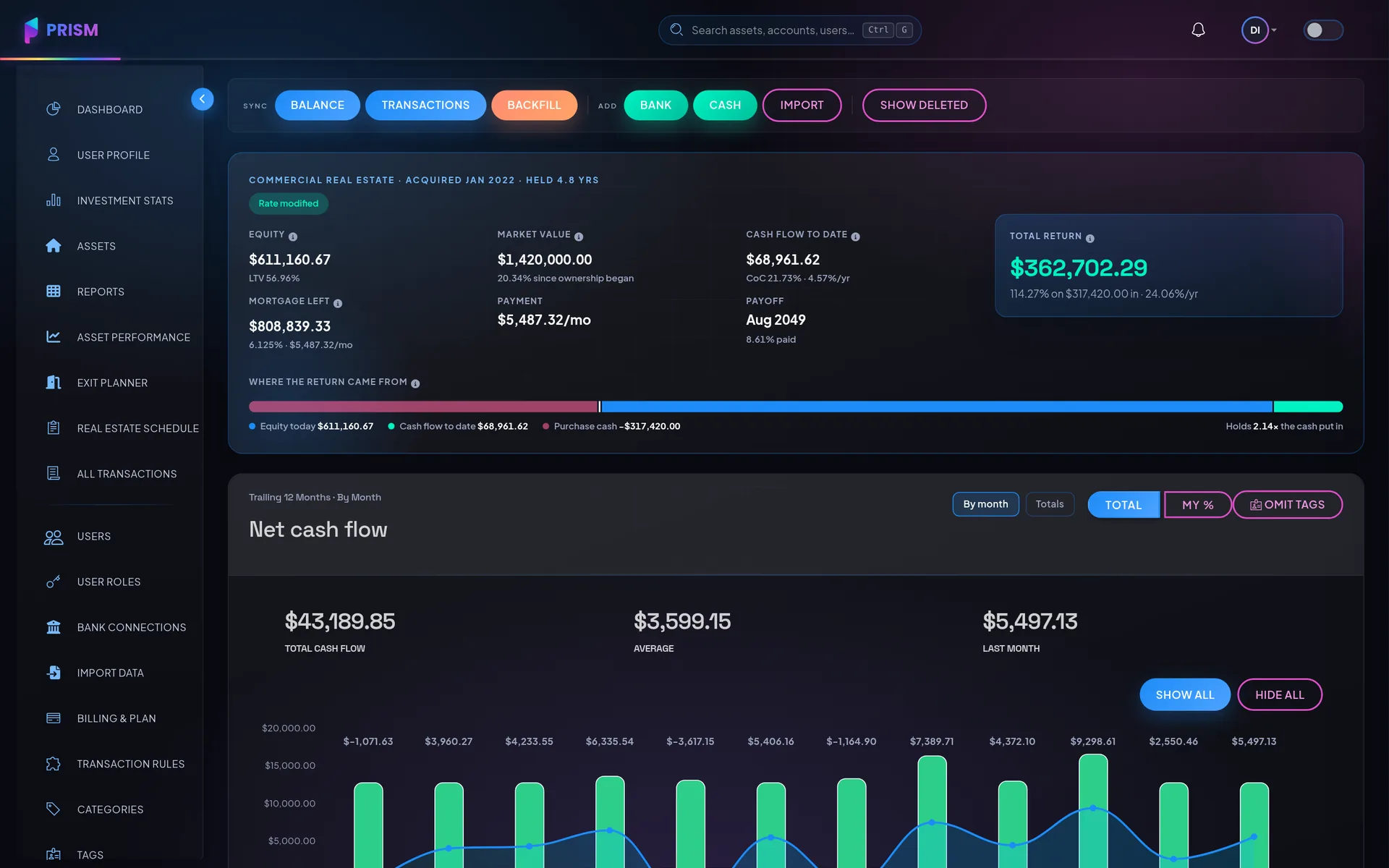
myprism.money/asset/transactions
One asset's synced transactions: the balance, transaction and backfill controls, a statement band with the total return, equity and loan, and a month-by-month cash flow chart
What it does

Many accounts, one asset

An operating account, a reserve account and a security-deposit account can all sit under one building.

Many assets, one connection

Several properties held at the same bank share a single connection, and each transaction still lands on the right one.

Pending becomes posted

A pending charge is shown as pending, then reconciled when it posts — not duplicated.

Cash still counts

Anything you did not pay from a connected account is entered by hand and behaves identically everywhere else.

How it works

Link the account

Through Plaid, in the bank's own login screen. Prism never sees the password.

History comes back

Past transactions arrive with the connection, so the books start full rather than empty — and anything older than the bank will send can be imported from a CSV, statement by statement.

New ones keep arriving

Synced on a schedule and routed by account, then categorized on the way in.

Questions
How do bank connections work?
Link an account in seconds through Plaid and Prism syncs your transactions automatically — no CSV exports or manual entry. Multiple assets can share one bank connection, and new transactions are routed to the right asset and categorized as they arrive.
My bank only synced a few months of history. Can I get the rest in?
Yes. How far back a connection reaches is the bank's choice — some send two years, some ninety days. Once an account is connected, the import wizard takes a CSV of the older statements, shows you where its synced history starts, imports only what the sync did not cover, and flags anything that looks like a duplicate. The same importer reads another tool's export, and every import can be undone in one click.
Can one property have more than one bank account?
Yes, and one bank connection can serve several assets. Transactions are routed to the right asset by the account they arrived on, so an operating account, a reserve account and a security-deposit account can all sit under the same building.
What about cash, Venmo, or a card I have not connected?
Enter it by hand. Manual transactions sit alongside synced ones and behave identically everywhere — categorization, splits, reports, per-asset performance. The books do not care where a number came from.
Is my financial data secure?
Yes. Bank connections run through Plaid — the same infrastructure used by Venmo, Robinhood, and thousands of financial apps — so Prism never sees your bank password. Everything is encrypted in transit with TLS and encrypted at rest in the database, the Plaid access token is encrypted a second time under a key we keep outside that database, and every account is isolated to your organization.

More of them on the full FAQ.

Put it to work on your own numbers

Add one asset, link one account, and see what a month looks like.