
Performance analytics

Metrics computed from the books, not typed into a form

Every number on the performance screen traces back to a transaction or a loan term you already recorded. There is no metrics tab to keep up to date, which is why the numbers are still right in March.
myprism.money/investment-stats
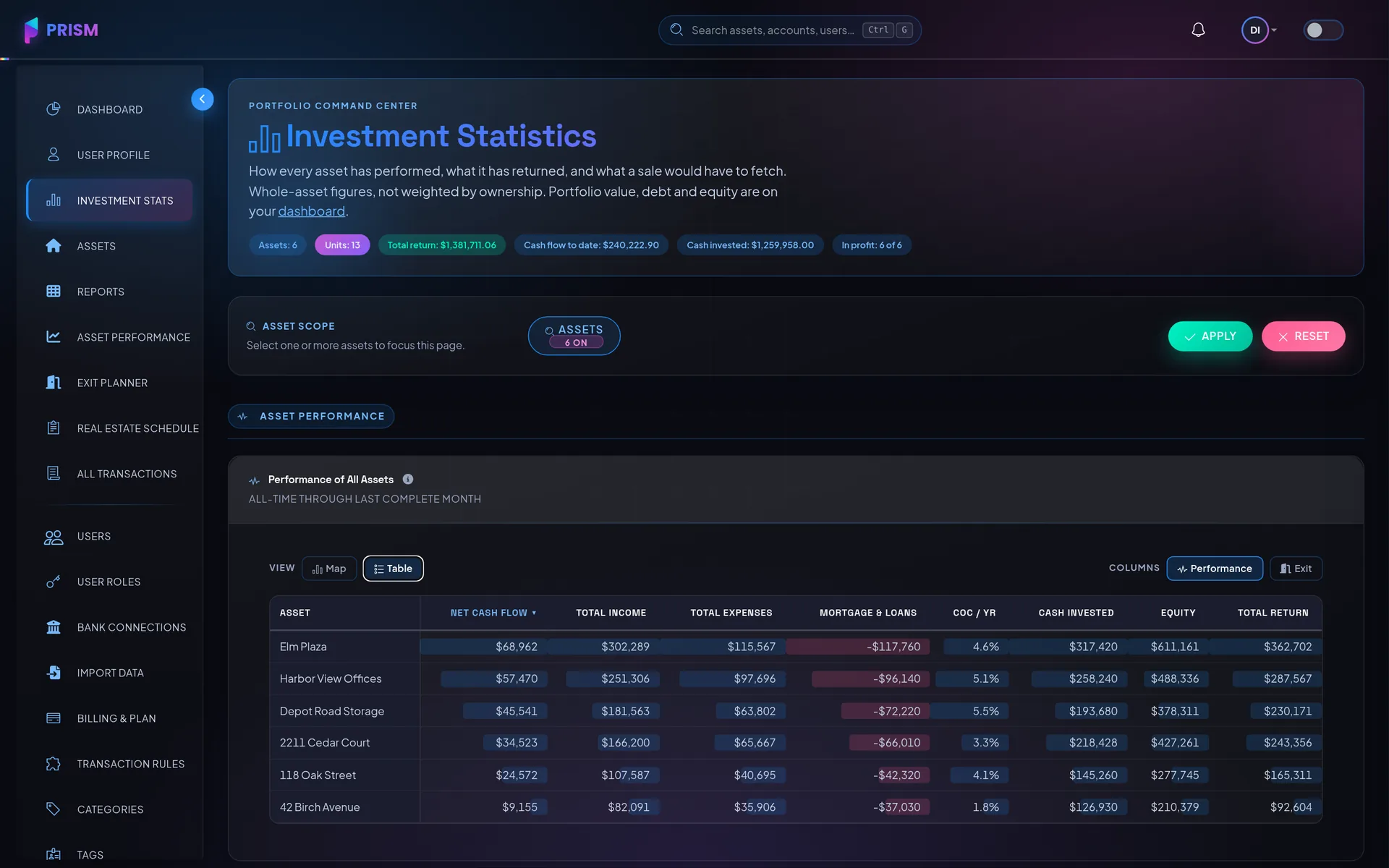
The investment statistics screen: total return, cash flow to date, cash invested and how many assets are in profit, over a table of every asset with its net cash flow, income, expenses, loan payments, cash-on-cash return, equity and total return
What it does

The six that matter

DSCR, cap rate, LTV, NOI, ROI and cash-on-cash return, per asset and rolled up across the portfolio.

Risk, not just return

Cash-flow stability, vendor concentration and interest-rate risk — the things that decide whether a good year repeats.

Your share or the whole asset

Ownership percentages are applied where they belong, so a partner sees their own numbers.

It moves when the books move

A recategorized transaction or a recorded refinance changes the metrics, because they are the same data.
myprism.money/investment-stats
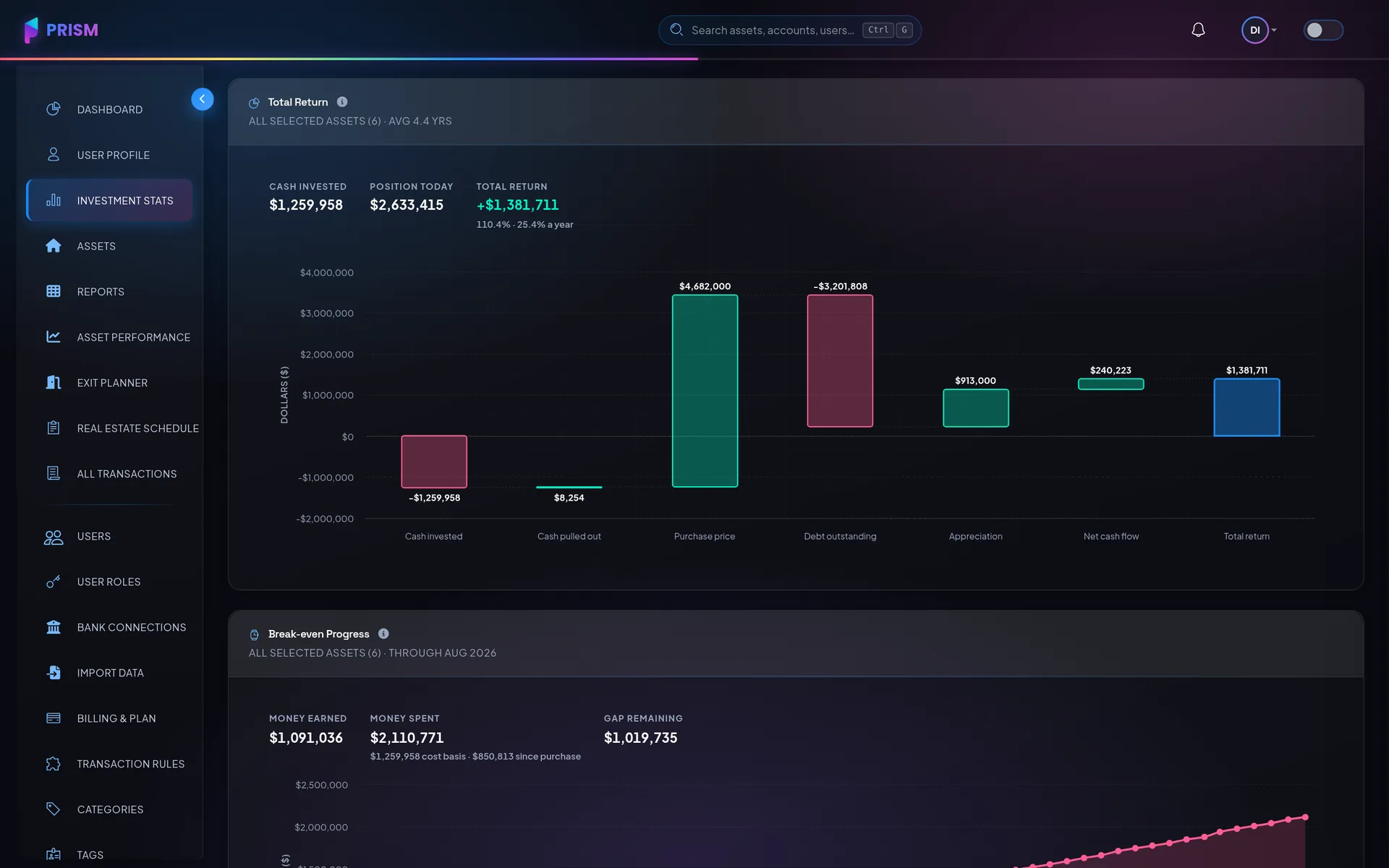
The same screen further down: a waterfall breaking total return into cash invested, cash pulled out, purchase price, debt outstanding, appreciation and net cash flow, above a break-even card showing money earned against money spent and the gap remaining

How it works

Record the asset

Purchase price, cash in, loan terms — the money questions asked in the words your deal actually used.

Let the transactions land

Bank sync and categorization decide what is income, what is an expense, and what is neither.

Read the metrics

Computed per asset over any window, and exportable with the rest of the reports.

Questions
Which performance metrics do you calculate?
DSCR, cap rate, LTV, NOI, ROI and cash-on-cash return, per asset and rolled up across the portfolio — plus cash-flow stability, vendor concentration and interest-rate risk. They are computed from your actual transactions and your actual loan terms, not from figures you type into a metrics screen. The performance suite is on Pro and up.
I own things with partners. Can I track just my share?
Yes. Ownership is recorded per asset as a percentage, and every change is written to an immutable audit log — so a split that moved two years ago is still answerable. Reports can be run at your share or at the whole asset, and each partner sees only the assets they are entitled to. Ownership tracking is on Pro and up.
Can my accountant use this at tax time?
That is what the reports are for. Income and expense reports break down by category and by asset over any date range, and export to Excel and PDF. The real-estate schedule lays every property out the way a Schedule E expects to see it. Your accountant does not need a login — though you can give them one, scoped to the assets they work on.

More of them on the full FAQ.

Put it to work on your own numbers

Add one asset, link one account, and see what a month looks like.