
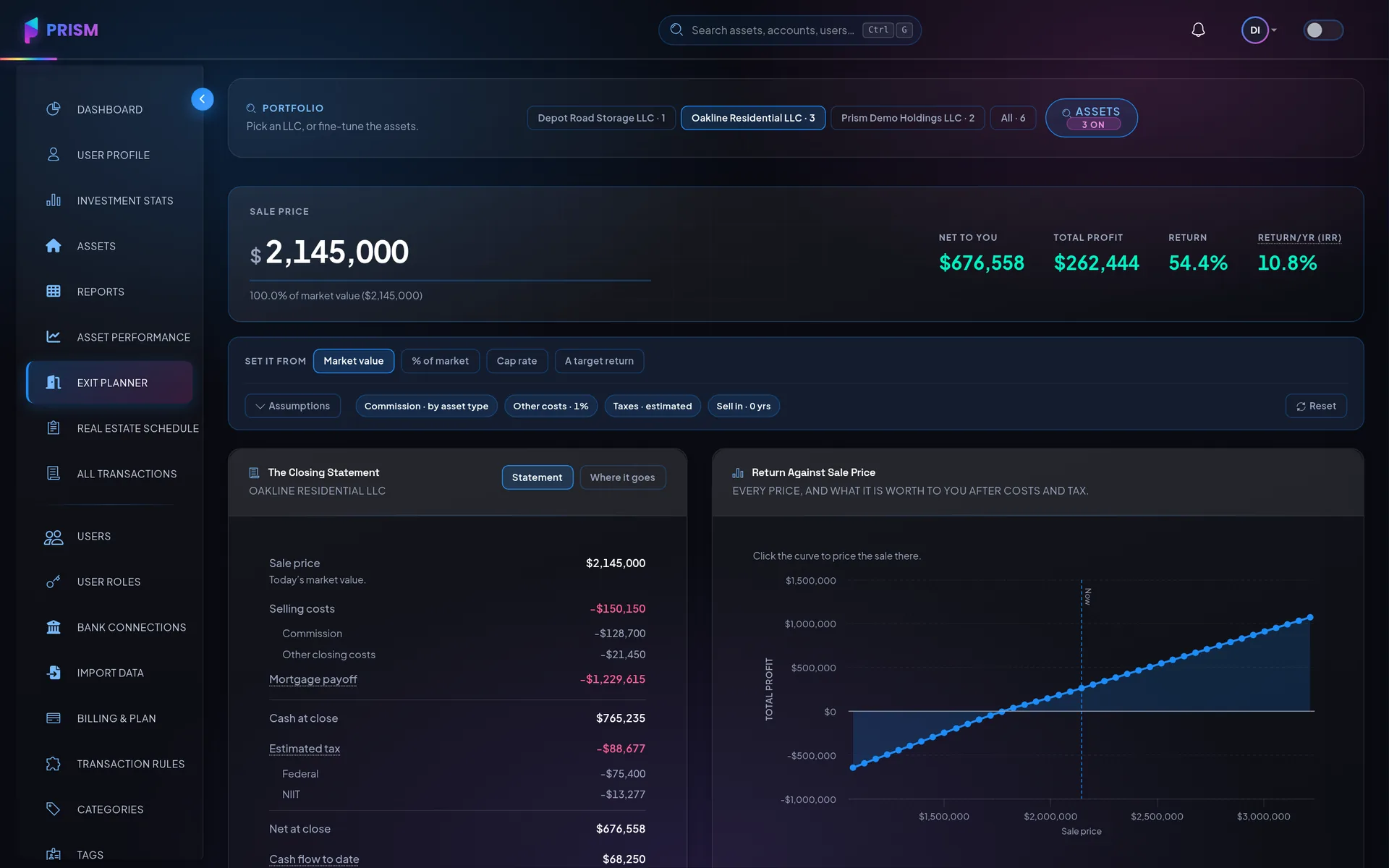
The closing statement, before you commit to close
A listing price is not what you keep. Commission, transfer taxes, the loan payoff, depreciation recapture and capital gains all come out of it first. The exit planner starts from your own books and works the whole thing down to net cash — with every assumed figure marked as one. Estimates for planning, not advice.
The answer first
One sale price, always editable, and beside it what that price is worth to you after everything comes out. Nothing needs filling in first — every assumption has a working default.
An honest tax estimate
Depreciation recapture, capital gains, state rates and the NIIT, modelled per asset from assumptions you can see and change. Estimates for planning — your CPA files the return.
Priced from your books
Set the price from market value, a percentage of it, an exit cap rate, an earnings multiple, or solve for a target return — the cap rate and multiple start at each asset's own.
Asset by asset
The portfolio total and each asset's own closing statement. Hover a row for the arithmetic; click one to focus every card on it.
How it works
Pick the scope
An LLC in one click, or fine-tune to any set of assets. The page opens on your biggest group.
Set the price
Type one, or derive it — percent of market, cap rate, earnings multiple, or a target return solved backwards to the price that reaches it.
Read what is left
Selling costs, payoff and the tax estimate, as a statement, a waterfall and a curve of every price against the return it leaves.
Can it tell me what I would actually keep if I sold?
Which performance metrics do you calculate?
More of them on the full FAQ.
Next to this
Put it to work on your own numbers
Add one asset, link one account, and see what a month looks like.